


Juego de los Diablitos in Curré/Yímba: A Cultural Unique Experience in Costa Rica
Table of Contents
El Juego de los Diablitos is one of the oldest indigenous ceremonies in Costa Rica. It commemorates the fight of our indigenous ancestors, against the Spaniards during the conquest, a battle to protect their land and culture.
During 2024, I visited the Indigenous territory of Curré/Yímba to witness this event firsthand. What I found most striking was how visitors are not just onlookers but become part of the community. The Boruca people show genuine hospitality, especially when you sit at the Diablitos’ ranch or take part in the game routes while sipping Chicha, listen to the locals share stories. And to those we thank because much of this article is thanks to these stories!
The Borucas
It is not possible to talk about the Juego de los Diablitos without talking a little about the Boruca. The Boruca are one of Costa Rica’s eight indigenous ethnic groups and have lived in the southern region of the country for centuries. Their territory is split between two large villages known as Brun̈cájc (Boruca) and Yímba Cájc (Rey Curré).
Throughout history, the Boruca have faced many challenges, yet they have managed to keep part of their culture alive. One of the most important traditions is the Juego de los Diablitos. This celebration honors the struggle of their ancestors during the time of the conquest and has become a strong symbol of their heritage.
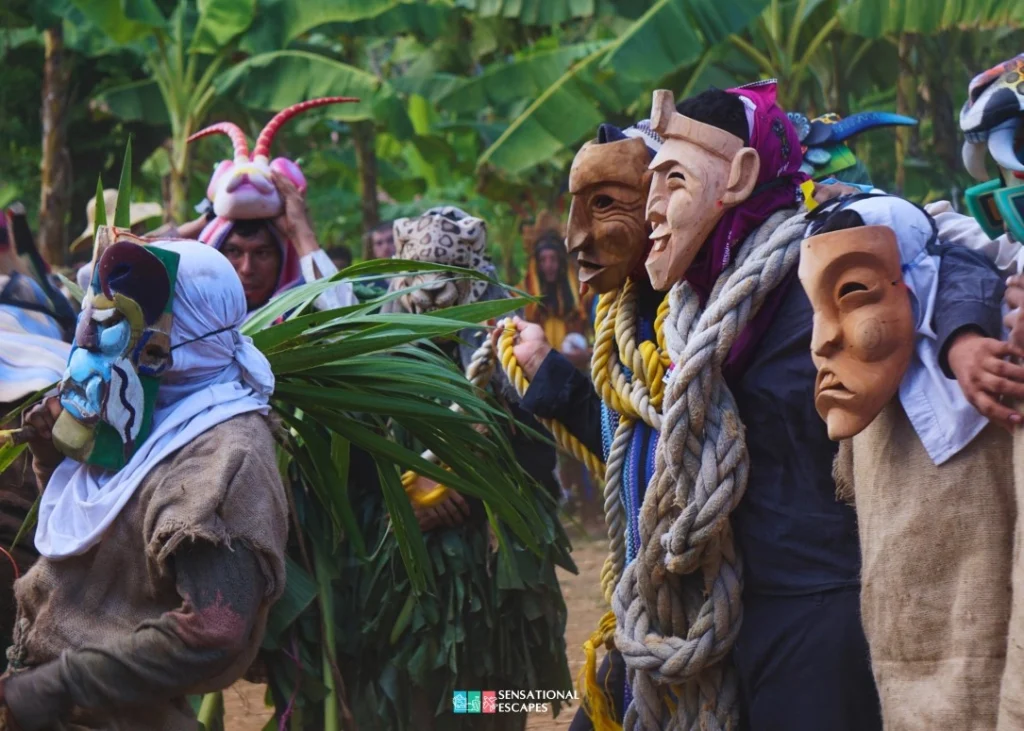
An essential part of this celebration are the wooden masks that the Boruca carve by hand. These masks, worn during the Juego de los Diablitos, have earned respect both inside and outside the country. Visitors often find them in local souvenir shops, where they represent a clear sign of Boruca craftsmanship.
Boruca Beliefs and Legends
Although most Borucas today are Christian, many of their ancestral beliefs and legends are still part of their culture. Stories about ancient gods and spirits continue to be passed down through generations, and play an important role in their traditions, including the Juego de los Diablitos.
- Sibö is known as the creator god and guide of indigenous peoples.
- Di Sujcra, the guardian of the waters. He is believed to live in the Térraba River and protect its flow and the creatures within it.
- Cuasrán, a character from colonial times who chose not to submit to the Spanish. Many Borucas believe he even make appearances during the Juego de los Diablitos.
Characters of the Juego de los Diablitos
Diablitos Mayores (Senior Devils)
These Diablitos are also known as “Mayores”. Their main job is to make sure that everyone respects the rules and traditions that are supposed to regulate this cultural event. They oversee the event, determine when each round starts and how long the game is to last at each house.
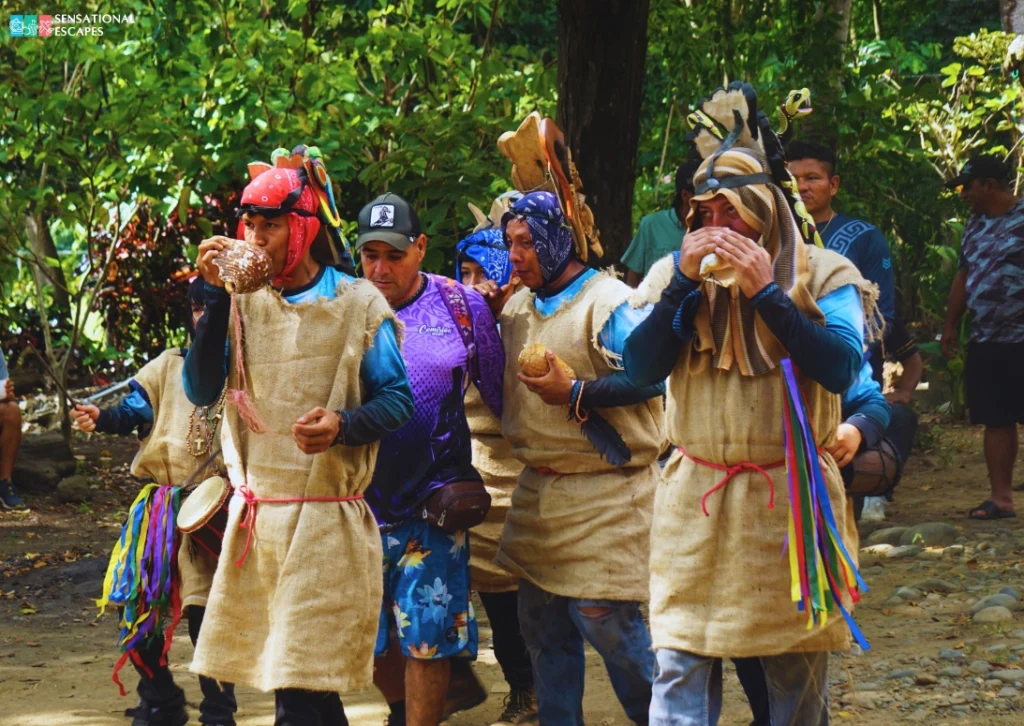
You can expect to see three ‘Mayores’: The main leader, the Diablo Mayor, and two assistants. Unlike the other devils they keep their masks reversed and never cover their faces. They are also the ones who play the snails, the traditional instrument that controls the game’s tempo.
As per Uriel Rojas, a member of the Curré/Yímba community, the Diablo Mayor is hereditary. It is from father to son, but not immediately. Future “Mayores” are trained for years before they are able to assume this role. This guarantees that the tradition is observed with the right amount of time and information as it has been for generations.

Diablitos Menores (Minor Devils)
The Diablitos Menores are the ones who really fight the bull in the Juego de los Diablitos. They wear traditional gangoche sacks and bright wooden masks, all different masks depict different spirits, ancestral figures or Costa Rican fauna. Over the three days, they fight symbolic battles, representing the resistance of the Boruca people against the Spanish.
During my visit, I heard an interesting legend from the community. It is said that one of the Diablitos Menores does not take off his mask for the entire three days. As the story goes, this is not any participant, this is Cuasrán, the spirit of a historical leader who refused to submit to the Spanish. It is said that every year he comes back to be a part of the game and watch over it, so that the tradition will remain alive, reminding us of the Boruca people’s strength and resistance.
Matadores (Matadors)
The Matadores are the Diablitos responsible for bringing down the bull in the final battle. Unlike the other minor Diablitos, they only appear on the last day of the Juego de los Diablitos.
Arreadores (Herders)
As for the Arreadores, they are not involved in the actual fight with the bull as much as the other Diablitos. They are in charge the group stays in check, assisting those who fall, and preventing anyone from getting lost during the long journeys through the community. While their main job is to watch over the other Diablitos, they can also interact with visitors, if the fight is taken outside the game area.
The way to recognize the Arreadores is from the large sticks they carry. Sometimes this is decorated with a jícara (a dried gourd) or colourful ribbons. They wear their masks backwards and usually have their faces uncovered.


El Toro (The Bull)
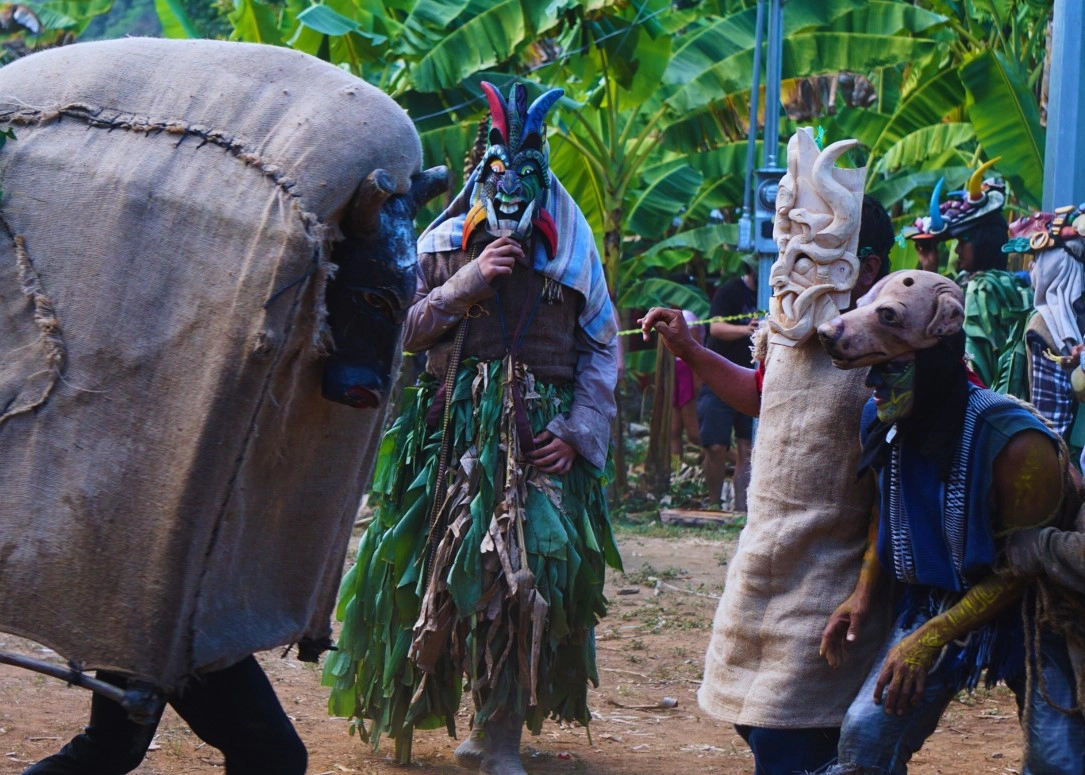
The Bull symbolizes the invaders, reflecting the Spanish who arrived during the conquest. Today, it represents anything that might put the community’s culture and territory at risk.
This figure is made of a large structure wrapped in gangoche sacks. A wooden bull mask is attached to the front, and a tail is set at the back to complete its look. Since it is heavy, it takes about 15 young men to play the role throughout the event. They take turns carrying it, switching out as the game progresses and the community calls them Toreros.
Some Minor Devils explained us that during the final act, the Matadors decapitate the Bull and preserve the mask to be used again in the following year’s celebration.
Diablitos Músicos (Musicians)
The Diablitos Músicos are usually kids or teenagers, but their role is huge. With their flutes and drums, they keep the rhythm going guiding the dance, the marches, and the fights.
They’re joined by an older musician from the community who plays the accordion. What stood out to us was that he never stops playing, no matter how long the event lasts. Sometimes he even played during the breakfast or lunch!!
Without them, the Juego de los Diablitos wouldn’t feel the same. Their music is what keeps everything moving.


Chronology of the Juego de los Diablitos
The Juego de los Diablitos is celebrated twice a year—first in the Boruca Indigenous Territory from December 31 to January 2 and then in the Curré/Yímba Indigenous Territory on the first weekend of February. It is an open event and both locals and visitors including foreigners are welcome to attend for free. The event is structured over three days and each stage is rich with cultural significance.
La Nacencia (The Birth)
The Juego de los Diablitos begins just before midnight, with a moment known as La Nacencia. A few hours before that, the Diablitos Menores silently climb a hill near the town of Curré/Yímba, and put on their gangoche sacks, the traditional wooden masks and then wait until midnight.
About midnight, locals and visitors are beginning to gathering at the foot of the hill. Firecrackers explode in the air at midnight, marking the official start of the event. The Diablitos Mayores start playing snail shells, with musicians following them with flutes, drums, and an accordion. The rest of the Diablitos Menores come down, embracing and solomando, which is a traditional Boruca cry.

First Day of Fight with the Bull
The first day of the fight starts early. At 6:00 a.m., the sound of firecrackers signals the beginning of breakfast at the Rancho de los Diablitos. Not many people arrive on time—most are still recovering from the long night of La Nacencia, with little sleep and plenty of chicha, however, those who make it early enjoy a traditional rice tamale with coffee.
At 8:00 a.m., the firecrackers go off again, followed by the deep sound of the snails blown by the Diablitos Mayores. This marks the start of the first battle against the bull. For the first time in the event, the bull appears, representing the Spanish invaders. The fight begins as they make their way through the town, stopping at different houses along the route. At each stop, the hosts serve chicha and provide a space for the Diablitos and the bull to fight.
At each stop, the Diablitos Menores tease and provoke the bull, jumping around it and making fun of it. But the bull does not hold back—it hits them hard, sending them tumbling to the ground. The loud cracking sounds of the balsa wood masks colliding and the thumps of bodies hitting the ground can be heard all around. The fights are intense, but also part of the game, showing the struggle between the Boruca people and their oppressors.
Around noon, the game pauses for a break, and everyone returns to the Rancho de los Diablitos for a meal. A hot bowl of vegetable soup with rice and pork is served, giving the participants the energy, they need to continue. After the meal, the firecrackers and snails sound once again, calling the Diablitos back into action. The fight continues with another tour through the village.

Second Day of Fighting with the Bull
The second day of the fight is quite similar to the first day in terms of the structure of the events, but there are some differences.
One of the most significant changes is in their clothing. In the afternoon, some Diablitos begin to decorate their gangoche sacks with banana leaves, making the sack itself almost disappear.
Meanwhile, the Diablitos Mayores, the musicians, and some of the arreadores change their sacks with a colorful woven, which according to the locals is made by the indigenous women of the community.
Their masks also become more complex, with more colors and decorations, which makes them look more eye-catching.
A new character appears on this day: the hunting dog. This Diablito wears a dog mask and sometimes behaves like one. Its role is to support the other Diablitos track and hunt the bull.
Just like on the first day, there are two tours through the town, in the morning and in the afternoon. However, the routes change, so each day’s combat seems distinct. On this day, a stop is made closer to the Grande de Térraba River, which shows that the Boruca people have a very close relationship with their land.

Third Day of the Fight with the Bull
The last and the third day of the Juego de los Diablitos is the most crowded one. The locals, neighbors from other communities, and the people from the Central Valley come here to watch the final fights. There are also a few foreign visitors, who are interested in this tradition. Because of the large crowd, ribbons are put in place to define the game area and to keep the spectators from stepping on the game – even though the game itself often expands beyond these limits.
By this day, even those who had not participated before are also part of the game thus the number of Diablitos is much higher. Their masks are even more colorful than the first two days; the participants have taken the time to add more details to their masks to make them stand out in the crowd.
The day begins like the first two days, with a morning tour of the town. But the afternoon is different. Right after a shorter tour, several important events occur, which signify the start of the last battle of the Juego de los Diablitos.

La Tumbazón and The Bull‘s Escape
At first, the game continues as usual. The Diablitos taunt and provoke the bull, while the bull charges and hits them hard. By this point, the blows are stronger, sometimes even going outside the playing area, making the crowd step back avoid getting caught in the action.
Suddenly, the snails of the Diablitos Mayores sound, signaling a shift in the game. The bull attacks, knocking down Diablitos, but this time, they don’t get up. This marks the beginning of La Tumbazón.
One by one, the Diablitos fall, staying on the ground. Even the musicians, many of whom are children.
Finally, the bull takes down the Diablo Mayor, the last to fall. The bull runs away to hide in the mountains.


Pursuit and Capture of the Bull
A few minutes after the bull runs away, the Diablitos begin to rise again. We heard two different explanations for this moment. Some say the Diablitos were never truly dead, just wounded or lying down. Others believe that it is the spirit of Cuasrán, who is said to appear during the Juego de los Diablitos, that revives them.
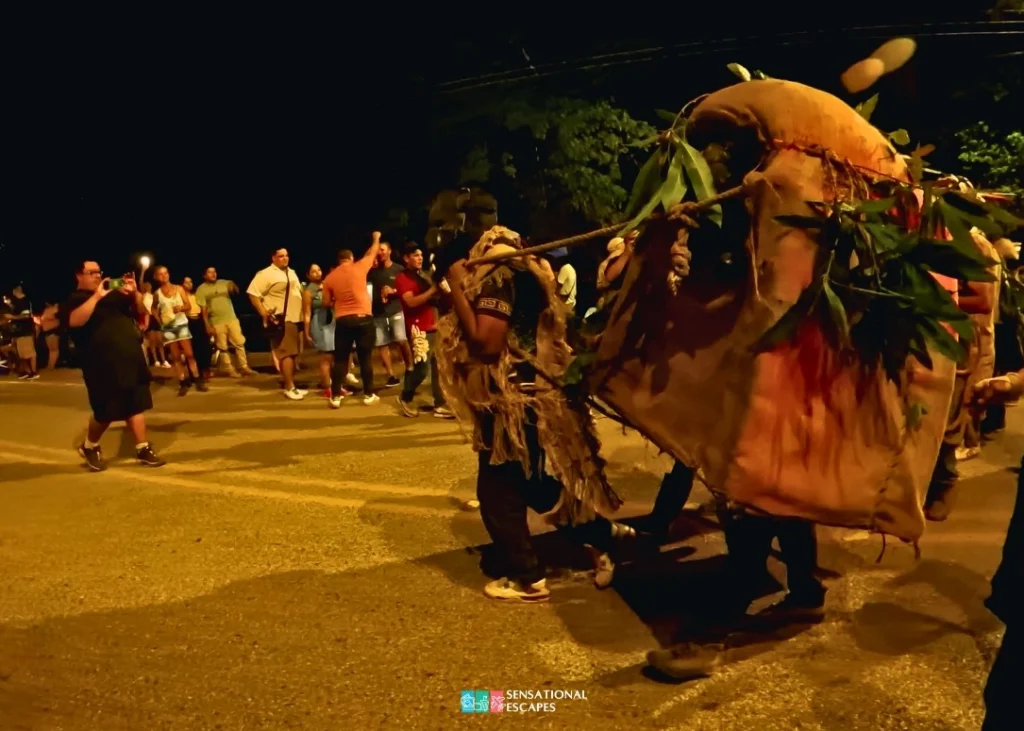
Regardless of the story, as soon as the Diablo Mayor blows the snail all the Diablitos jump to their feet. Without hesitation, they begin searching for the bull, running through the streets of the town. When they finally find it, the bull is covered in leaves and twigs, as if trying to blend into the surroundings. But there is no escape. The Diablitos throw ropes around it, capturing it once and for all. From there, they drag it to the town square, near the Diablitos’ ranch, where the final act of the game will take place—the burning of the bull.
Killing of the Bull and Victory of the Diablitos
At the town square, people had already started to come in to watch the Bull burn. The energy of the final battle could be felt in the atmosphere.
At the beginning, some Diablitos bring the Bull in, tied with ropes, while others prepare the bonfire.
The bull is dragged near the fire and when it is close, it is shoved in. The bull is burning, but it is taken out again, and they walk it around the square on fire and then throw it back into the bonfire to finish it off.
When the bull is finished, the Diablitos take a position in the center of the square. They shout, dance and celebrate their victory. The crowd cheers and applauds and thus brings an end to the Juego de los Diablitos for another year

Do you want to see the whole celebration in more detail? Watch our Juego de los Diablitos video!!
Gastronomy and Traditional Beverages
A visit to the Juego de los Diablitos is not complete without trying the traditional food and drinks that are an essential part of the celebration.
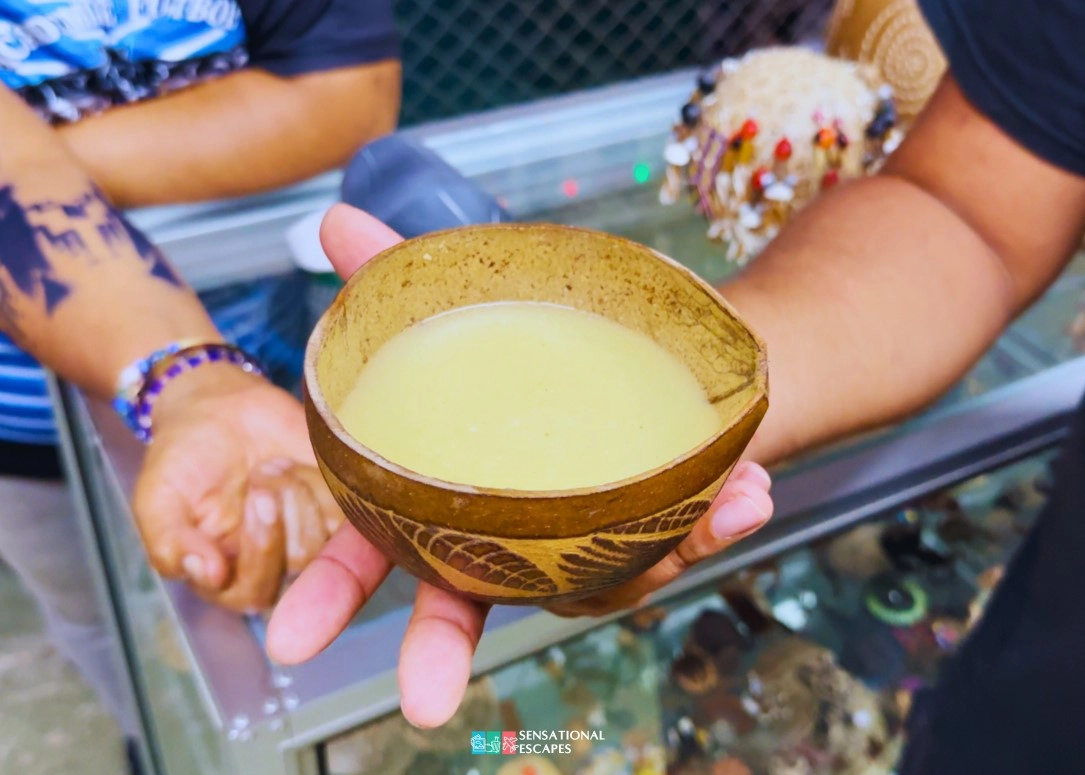

The Chicha
This age-old beverage is usually prepared from fermented corn with sugar cane, however, people in Curré/Yímba also use pejibaye or banana. Every family has its own way of making the brewing so the taste of the chicha may differ from one batch to another, some may be sweeter than the others while others may have a more fermented taste.
Chicha is everywhere during the Juego de los Diablitos. There is always a pot of chicha at the Diablitos’ ranch, and in the houses where the Diablitos go to play, the owners are willing to provide chicha to the Diablitos and visitors.
Chicha is not only a drink; it is an important part of the game. The Diablitos drink chicha to keep going, to cheer up and to be able to play for days on end while fighting the bull.

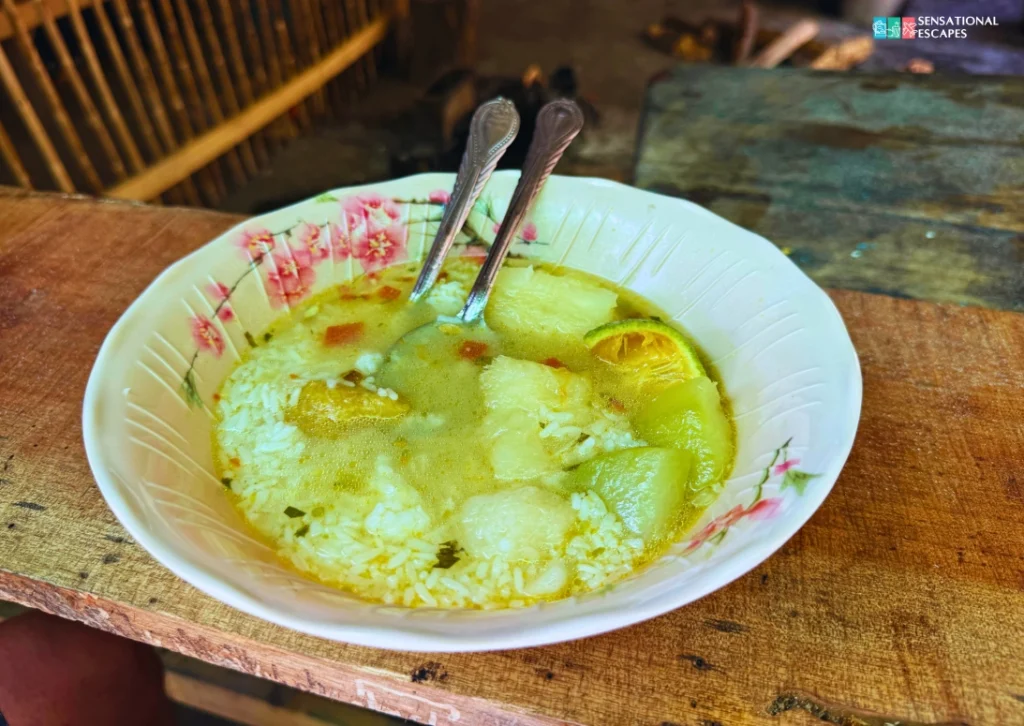
Gastronomy
Along with the thrill of the game and the clash with the Bull, there is one more aspect that is usually not noticed: the daily meal at the Diablitos’ ranch.
From early in the morning, a group of women led by Doña Emilce, spend the three days cooking breakfast and lunch. The food is the same for three days, but the workload is enormous. They are not only cooking for the Diablitos but for the people who come to experience the tradition as well.
Breakfast is usually a rice tamale or gallo pinto, which is served with pork rinds and black coffee. For lunch, they prepare a vegetable soup with rice and pork. All the food is cooked on a wood fire, which enhances its flavor.
However, this meal is not just a way to satisfy one’s hunger; it has a clear function: to provide energy to the Diablitos, so that they can go on fighting the bull for as long as is needed for the game.
The Diablitos eat first by tradition, and everyone else is welcome to share the meal for free. This open invitation reflects the spirit of community and hospitality that is central to the Juego de los Diablitos. Each dish is an offering of dedication to maintain the core values of the celebration: resistance, unity, and tradition.

on the right) and other women preparing the soup
Getting to Curré/Yímba
By Car
The community of Curré/Yímba is located about five hours from San José. There are two main routes to get there by car: Route 34 (Costanera Sur) and Route 2 (Inter-American Highway).
Route 2 crosses through mountainous areas, so traveling at night is not recommended because of possible fog. Route 34 runs near the coast and is popular for those heading to places like Jacó, Uvita, or Corcovado.
If you are coming from Guanacaste, the distance is roughly 390 kilometers, taking a little over six hours by way of Route 1 (Interamerican Highway) before joining the Costanera Sur. No matter if you are traveling from Guanacaste or San José, the roads are generally in good shape, so a four-wheel-drive vehicle is not required. However, traffic can be heavy at times, which might extend your driving hours.
Once you arrive in Rey Curré, you can usually find parking near the Communal Ranch, where many people leave their cars. There is also parking in front of the Communal Ranch, in the other side of the road. On the third day of the Diablitos festival, more vehicles start arriving around midday, so it’s wise to get there before noon to secure a spot. Some local residents also rent out spaces on their properties for parking, offering another option if the main lots are full.


By Public Transportation
If you are traveling by bus, the company Tracopa operates routes that stop in Rey Curré.
Buses leave from San José and typically take Route 2 (Interamericana Sur). There is only one schedule that follows Route 34 (Costanera Sur). But you can check schedules, routes, and fares in Tracopa’s website.
While tickets cannot be purchased directly from their site, Tracopa is partnered with the Passer app, where you can buy bus tickets online.
Check the Tourist Map for Bus stops.

Tips for Visiting Curré/Yímba
- Carry cash: There are no ATMs in the community, and most payments are made in cash. Having cash on hand will make it easier to buy food, drinks, or souvenirs.
- Dress comfortably: Wear light clothing and closed-toe shoes. The terrain is uneven, and activities last several hours.
- Respect the culture: Taking photos is allowed, but be mindful not to disrupt the game.
- Buy handicrafts directly from local artists: You’ll get a better price than in souvenir shops, and your purchase supports the community. If you’re lucky, you might even find masks that were used in the Juego de los Diablitos.
- Bring insect repellent and sunscreen: You will be outside for long periods, and the sun and mosquitoes can be intense.
